

Introduction: Why Control Algorithms Matter in Electric Drives
As electric mobility evolves, users expect motors that are not only powerful but also smooth, quiet, and energy-efficient.
This is where FOC — Field-Oriented Control — becomes a defining technology.
In simple terms, FOC allows the controller to drive a BLDC (Brushless DC) motor like a precisely tuned instrument, adjusting torque and speed in real time.
For electric bicycles, scooters, and motorcycles, this means instant response, smoother acceleration, higher efficiency, and lower noise.
Em JRAHK, our Controladores FOC sinusoidais de três modos da série Gold are built around this advanced control concept, bringing premium performance to the next generation of personal and industrial electric vehicles.
The Evolution from Square-Wave to FOC
Traditional BLDC motor controllers used square-wave (or trapezoidal) commutation — a simple method that switches the current between motor phases every 60 degrees.
While effective, it comes with limitations:
- Audible motor noise
- Less efficient energy use
- Torque ripple at low speed
To overcome these issues, engineers developed sine-wave control — driving the motor with sinusoidal current waveforms.
This already made operation smoother.
But FOC went further:
Instead of controlling each phase independently, it transforms motor control into a rotating reference frame, aligning magnetic fields dynamically for maximum torque and minimum loss.
In other words, FOC doesn’t just push current into the motor — it “thinks” about where to push it.
The Principle Behind Field-Oriented Control
To understand FOC, imagine a BLDC motor as having two magnetic fields:
- O rotor field (created by the permanent magnets)
- O stator field (created by current in the motor windings)
The goal is to keep these two fields perpendicular (90° apart) at all times — this ensures the highest torque output for the least electrical power.
The d-q Coordinate Transformation
Instead of thinking in three motor phases (A, B, C), FOC mathematically converts them into two virtual components:
- d-axis (direct axis) — aligns with the rotor’s magnetic field
- q-axis (quadrature axis) — perpendicular to the rotor field
The controller then:
- Measures or estimates rotor position (using Hall sensors or back-EMF).
- Converts the three-phase currents into the d–q frame (using Clarke and Park transformations).
- Regulates the d-axis current (magnetic flux) and q-axis current (torque) separately.
- Converts them back to three-phase signals and applies them through PWM to the MOSFETs.
This enables vector control — torque control that is linear, fast, and efficient.
FOC in Action: Real-World Example from JRAHK
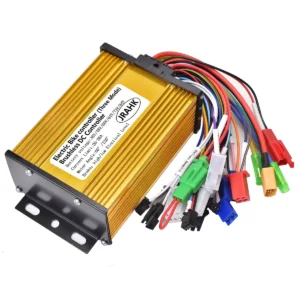
Let’s take the JRAHK Three-Mode Gold Series Sine FOC Controller as an example.
When you twist the throttle or begin pedaling:
- The controller instantly calculates rotor position and speed.
- FOC algorithms determine the ideal d-q current values.
- MOSFETs are switched with high-frequency PWM signals to shape the current waveform.
- The result: smooth torque, silent operation, and efficient battery usage.
Even during rapid acceleration or heavy load (such as climbing a hill or carrying cargo), the motor feels steady and predictable — because the FOC loop keeps magnetic torque and flux optimized in real time.
Hardware Requirements for FOC
Implementing FOC requires higher computational precision and sensor feedback than a square-wave system.
That’s why advanced FOC controllers like JRAHK’s use a combination of:
| Component | Function in FOC System |
|---|---|
| MCU (Microcontroller) | Runs complex vector algorithms at high frequency |
| MOSFET Power Stage | Provides rapid current switching (e.g., 9–24 tube designs) |
| Current Sensors | Measure real-time phase currents for closed-loop control |
| Rotor Position Sensors (Hall/Encoder) | Detect rotor angle for coordinate transformation |
| PWM Driver ICs | Convert MCU logic into high-power switching signals |
| UART / CAN Interface | Enables communication with display or external diagnostics |
This integration of sensing, computation, and power electronics is what makes an FOC controller far more “intelligent” than a simple square-wave driver.
Benefits of FOC Control
Field-Oriented Control delivers measurable improvements across performance, comfort, and efficiency:
| Benefit | Explanation |
|---|---|
| High Efficiency | Current and torque are optimized at every moment, minimizing energy loss. |
| Smooth & Silent Operation | Sine-wave current eliminates torque ripple and motor noise. |
| Strong Torque Response | Independent control of flux and torque enables immediate acceleration. |
| Temperature Control | Less wasted energy reduces heat generation in the motor and MOSFETs. |
| Travagem regenerativa | FOC easily supports smooth, controllable energy recovery. |
| Versatility | Works with both sensored and sensorless BLDC motors. |
In tests conducted across multiple electric vehicle applications, FOC has shown 5–15% higher overall efficiency compared to standard six-step control, particularly under variable load conditions.
Sensor vs. Sensorless FOC
JRAHK’s FOC controllers support both control modes:
Sensored FOC
Uses Hall sensors or encoders to determine rotor position.
- Pros: Excellent low-speed startup and hill-climbing torque.
- Ideal for: Cargo bikes, e-motorcycles, industrial applications.
Sensorless FOC
Estimates position from back-EMF and current feedback.
- Pros: Fewer wires, lower cost, more durable (no sensor failures).
- Ideal for: Shared scooters, mid-speed e-bikes, and sealed systems.
Dual-Mode Auto Detection
Many JRAHK models feature automatic detection — the controller identifies whether sensors are present and switches to the correct algorithm, ensuring plug-and-play versatility.
Comparing FOC with Conventional Controllers
| Caraterística | Square-Wave Control | Sine-Wave Control | Controlo orientado para o terreno (FOC) |
|---|---|---|---|
| Current Waveform | Trapezoidal | Sinusoidal | Vector-controlled sinusoidal |
| Ondulação de binário | Elevado | Medium | Very low |
| Noise | Audible | Quiet | Praticamente silencioso |
| Eficiência | Moderado | Good | Excelente |
| Dynamic Response | Limited | Smooth | Instantaneous |
| Cost/Complexity | Low | Medium | Elevado |
| Typical Application | Entry-level scooters | Mid-range e-bikes | High-performance EVs, motorcycles |
By combining sine-wave hardware com FOC algorithms, JRAHK achieves both smoothness and efficiency — without compromising reliability.
Design Highlights of JRAHK FOC Controllers
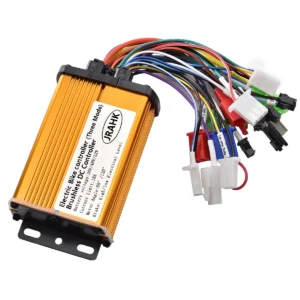
JRAHK's Three-Mode Gold Series demonstrates what an advanced FOC platform looks like:
- Power Range: 250 W - 5000 W
- Voltage Options: 36 V – 84 V
- MOS Tube Variants: 6 / 9 / 12 / 15 / 18 / 24
- Current Handling: Up to 80 A continuous
- Control Modes: Sine-wave, FOC, Square-wave
- Protocols: UART interface for display communication
- Protection: Over-voltage, over-current, over-temperature, reverse polarity
Each model is built in a high-strength aluminum housing for efficient heat dissipation, ensuring reliable operation under high-load and continuous-duty conditions.
Applications of FOC Controllers
Because of their smooth torque and high precision, FOC controllers are widely used in:
- High-end e-bikes and cargo bikes – for quiet, natural pedal-assist feel
- Electric scooters – smooth throttle and regenerative braking
- Electric motorcycles – high torque and strong acceleration
- Robotics and AGVs – precise motion control and low noise
- Industrial drives – efficient continuous operation
In every case, the benefits translate directly into longer battery life, cooler operation, e better rider comfort.
Future Outlook: Toward Smart FOC Systems
As IoT and AI technologies continue to evolve, the next generation of FOC controllers will integrate:
- Adaptive learning algorithms for self-tuning control loops
- Cloud connectivity for performance monitoring
- Predictive diagnostics for motor and battery health
- CAN and BLE communication for smart vehicle integration
JRAHK’s R&D roadmap is already aligned with these trends — developing smart BLDC controllers that bring intelligent power management and data connectivity into one seamless platform.
Conclusion
Field-Oriented Control represents the cutting edge of brushless motor technology.
By continuously aligning the magnetic fields inside the motor, FOC achieves a perfect balance of power, efficiency, and smoothness.
For manufacturers and riders alike, this means:
- Quieter vehicles
- Faster response
- Longer range
- Smarter energy management
Em JRAHK, our mission is to make these benefits accessible across electric mobility — from lightweight e-bikes to high-performance motorcycles.
With years of R&D in intelligent motor control, our FOC sine controllers are not just components — they are the foundation for a smoother, more efficient future of electric transportation.
 English
 Spanish
 Portuguese
 French
 Russian
 Korean
 Arabic
 Italian
 German