

Introduction: Why the Controller Is the “Brain” of Every Electric Drive
At the heart of every electric two-wheeled vehicle lies not just the motor, but the controller — the intelligent unit that determines how efficiently, smoothly, and safely the motor operates. In the case of BLDC (Brushless DC) motors, the controller plays an even more critical role because, unlike brushed motors, BLDC motors do not have mechanical commutators.
Instead, the controller electronically switches the motor windings at the right time, transforming DC battery power into precise rotational motion. Whether it’s for an electric bicycle, scooter, or motorcycle, choosing the right controller can make the difference between smooth acceleration and jerky or inefficient performance.
JRAHK’s range of Sine-wave FOC Controllers, Dual-mode Square Wave Controllers, y Integrated Display Kits are designed to meet diverse application needs, combining robust power output with intelligent control algorithms.
Understanding the Basics of a BLDC Motor Controller
A Brushless DC Motor Controller regulates how power from the battery flows into the motor. It adjusts voltage, current, y timing based on the rotor’s position to generate smooth rotation and the desired torque.
In simple terms, it performs three key tasks:
- Commutation Control – It electronically switches current among motor phases to produce continuous rotation.
- Speed and Torque Regulation – It controls how fast and how strongly the motor spins by varying current and voltage.
- Protection and Communication – It safeguards against over-current, overheating, or low voltage, while exchanging data with the vehicle’s display or control unit.
Without the controller, a BLDC motor cannot operate properly because it needs these precisely timed electrical signals to keep spinning.
Core Components of a BLDC Controller
A typical JRAHK BLDC controller includes:
- MOSFET Power Stage: The main current-switching elements. For example, our 9-Tube to 24-Tube controllers use multiple parallel MOSFETs to handle different current levels (from 18A up to 80A).
- Microcontroller (MCU): The logic brain that manages switching sequences, reads sensor inputs, and applies control algorithms such as FOC (Field-Oriented Control).
- Driver ICs: They amplify MCU signals to drive the MOSFETs precisely.
- Current and Voltage Sensors: For closed-loop feedback to maintain stability and protect the system.
- Communication Interface: Many of our kits support UART protocol, allowing easy data exchange with external displays.
- Protection Circuits: Against over-voltage, reverse polarity, or short circuits.
Types of Control: Square Wave vs. Sine Wave vs. FOC
Different control methods offer different riding experiences. JRAHK provides both square-wave and sine-wave FOC options to suit varied user needs.
1 Square-Wave Control
- Generates a trapezoidal current waveform.
- Easier and cheaper to implement.
- Offers strong torque but higher noise and less smoothness.
- Ideal for basic scooters or entry-level e-bikes.
Example: JRAHK Square-Wave Controller Kits (6–15 Tube Models, 250W–2000W).
These units provide dependable power for small-to-medium e-bike systems, with UART interface and optional display integration.
2 Sine-Wave Control
- Produces a sinusoidal current waveform that matches the motor’s rotation angle.
- Smoother and quieter operation with higher efficiency.
- Reduces vibration and mechanical wear.
Example: Sine BLDC Controller Kits (9-Tube, 15-Tube, 400W–2000W),
designed for riders demanding refined performance and minimal noise.
3 Field-Oriented Control (FOC)
- The most advanced algorithm used in high-performance systems.
- It transforms motor phase currents into a rotating reference frame (d–q axis) and controls torque and flux independently.
- This allows precise torque output, improved energy efficiency, and optimal performance across load conditions.
Example: Three-Mode Gold Series Sine FOC Controllers from JRAHK (6- to 24-Tube models, up to 5000W).
These controllers integrate sine-wave drive, FOC algorithm, and dual-mode operation — allowing flexible use with both Hall-sensor and sensorless motors.
Hall Sensor vs. Sensorless Control
A BLDC controller determines the rotor’s position to time the commutation properly. This can be done in two ways:
- With Hall Sensors: The motor provides position signals through sensors embedded inside. The controller reads them to synchronize the switching.
- Advantages: Smooth start, better low-speed control.
- Disadvantages: Slightly higher cost and more wiring.
- Sensorless (Back-EMF Detection): The controller estimates rotor position from the voltage feedback generated by the motor itself.
- Advantages: Simpler wiring, more reliable in harsh environments.
- Disadvantages: Slight delay in startup and less precise at very low speed.
Most JRAHK controllers support dual-mode operation, automatically detecting whether a Hall sensor is connected — ensuring compatibility across a wide range of motors.
Understanding Controller Specifications
When choosing a controller, you’ll see parameters such as Tensión, Actual, Potencia, y MOS Tube Count. Here’s what they mean:
| Parameter | Meaning | Example from JRAHK Line |
|---|---|---|
| Tensión | Input battery voltage range | 36–48–60–72–84 V |
| Actual | Maximum continuous phase current | 18A – 80A |
| Potencia | Motor power capability | 250 W – 5000 W |
| MOS Tube | Number of switching transistors, affects current handling and heat dissipation | 6 / 9 / 12 / 15 / 18 / 24 tubes |
| Protocol | Communication interface for display or diagnostic tools | UART |
| Control Mode | Square, Sine, or FOC | “Three-Mode Gold Series Sine FOC” |
For instance:
- A 6-Tube 36 V controller (18 A, 250–400 W) fits a standard commuter e-bike.
- A 15-Tube 60 V controller (40 A, 2000 W) suits heavy-duty cargo or delivery scooters.
- A 24-Tube 84 V controller (up to 5000 W) is ideal for high-performance motorcycles.
Three-Mode Gold Series: Intelligent Flexibility in One Controller
JRAHK’s Three-Mode Gold Series Sine FOC Controllers represent a next-generation design for high-efficiency electric drives.
Each model combines three operating modes in a single housing:
- Sine-Wave FOC Mode: Smooth, efficient, and quiet operation.
- Square-Wave Mode: Simple and powerful for heavy-torque start-ups.
- Self-Learning Mode: Automatically adjusts parameters to match various motor characteristics.
With models ranging from 6-Tube (250 W) to 24-Tube (5000 W), and voltages up to 84 V, this series provides a scalable solution for everything from compact bicycles to electric motorcycles.
Their gold-anodized aluminum housings are both lightweight and heat-resistant, ensuring stable operation under continuous high-load conditions.
Dual-Mode Blue Square Wave Controllers: Durable and Adaptable
For customers requiring a balance between simplicity and power, JRAHK’s Dual-Mode Blue Square Wave Series offers reliable performance with dual control compatibility.
They support both sensor and sensorless BLDC motors, with current ratings up to 60 A and power up to 5000 W.
The 24-Tube variant, for example, provides a high-current drive for larger scooters and motorcycles, maintaining strong acceleration and torque output while remaining cost-efficient.
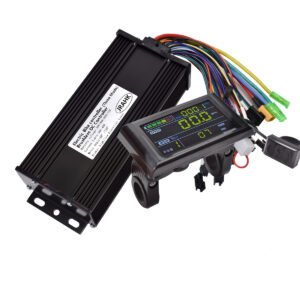
Controller Kits with Integrated Displays
JRAHK also provides complete controller + display kits, simplifying installation and tuning.
- Square-Wave Controller Kit: 6–15 Tube versions, UART communication.
- Sine-Wave Controller Kit: 9- and 15-Tube versions for higher refinement.
The included displays provide real-time data such as speed, battery level, assist mode, and fault codes — essential for accurate diagnostics and better riding experience.
These kits are ideal for OEM projects or aftermarket upgrades, where plug-and-play installation is key.
Protection and Safety Features
Modern BLDC controllers integrate multiple safety layers to ensure reliable operation:
- Over-Voltage and Under-Voltage Protection
- Over-Current Limiting and Short-Circuit Protection
- Over-Temperature Monitoring
- Phase Loss Detection
- Reverse Polarity Protection
These features protect both the controller and the motor, extending system lifespan and preventing costly damage.
Typical Applications
BLDC controllers are widely used in:
- E-Bikes and Cargo Bikes – Smooth, efficient motor control for commuting and logistics.
- Electric Scooters and Motorcycles – High-torque acceleration and regenerative braking.
- Industrial Equipment – Conveyor systems, AGVs, robotic arms.
- Shared Mobility Fleets – Reliable long-life control units with smart connectivity.
JRAHK controllers are specifically designed for personal mobility, shared transportation, y industrial drive applications, ensuring durability and precision under all operating conditions.
Summary: Why Choose JRAHK BLDC Controllers
| Feature | JRAHK Advantage |
|---|---|
| Product Range | 6 – 24 Tube models covering 250 W – 5000 W |
| Voltage Compatibility | 36 V – 84 V systems |
| Control Algorithms | Square Wave, Sine Wave, and Advanced FOC |
| Dual-Mode Support | Works with Hall-sensor and sensorless motors |
| Display Kits | UART communication + integrated user interface |
| Build Quality | Aluminum alloy casing, efficient heat dissipation |
| Protección | Comprehensive electronic safeguards |
Whether you need a compact controller for an urban e-bike or a robust system for a heavy electric motorcycle, JRAHK provides a complete solution that balances performance, reliability, and cost-efficiency.
Conclusion
A BLDC motor controller is far more than a simple power converter — it’s the intelligent link that connects your battery, motor, and riding experience.
Through decades of R&D and precision manufacturing, JRAHK delivers high-quality controllers that enable stable, efficient, and intelligent motor operation across a range of applications.
From sine-wave smoothness to high-torque square-wave acceleration, from 36 V city e-bikes to 84 V performance motorcycles — JRAHK’s BLDC controller lineup is engineered to move the world forward with power and control.

 English
 Spanish
 Portuguese
 French
 Russian
 Korean
 Arabic
 Italian
 German