

1. Introduction: Efficiency Is the Heart of Electric Mobility
In the electric vehicle world, efficiency defines everything — how far you can go, how long the battery lasts, and how much heat your system generates.
While the motor and battery get most of the attention, the وحدة التحكم is the true performance architect behind it all.
A وحدة التحكم في المحرك BLDC (تيار مستمر بدون فرش) doesn’t just feed power to the motor; it decides how that power is used.
An intelligent, efficient controller can turn the same watt-hours into more distance, smoother torque, and cooler operation.
في JRAHK, we’ve spent years refining motor control algorithms and power electronics to deliver maximum output per joule — ensuring our customers’ vehicles are not just powerful, but smartly efficient.
2. What Does Efficiency Mean in a BLDC Controller?
In simple terms, efficiency measures how effectively a controller converts electrical power from the battery into mechanical power at the motor shaft — while minimizing losses through heat, switching, or magnet misalignment.
The formula looks like this:
\text{Efficiency} = \frac{\text{Mechanical Power Output}}{\text{Electrical Power Input}} \times 100\%
But in practice, efficiency is influenced by many interacting elements:
- إن control algorithm (Square Wave, Sine Wave, FOC)
- إن MOSFET switching stage and power layout
- Current sensing and timing precision
- Thermal design and housing material
- Motor-controller compatibility and calibration
Even small improvements — say, 3–5% — can translate to longer range, lower heat, و higher reliability in e-bikes, scooters, and motorcycles.
3. Sources of Power Loss in Conventional Controllers
Every BLDC controller experiences power loss, primarily in four forms:
- Conduction Losses: Current flowing through MOSFETs and wires generates heat due to resistance.
- Switching Losses: During high-frequency switching, energy is lost each time a transistor turns on/off.
- Magnetic and Commutation Losses: Improper timing or waveform distortion causes inefficient torque production.
- Control Losses: Poor algorithms or low-resolution sensing lead to inaccurate torque control and wasted current.
These inefficiencies add up — a standard six-step square-wave controller may operate at 75–85% efficiency, while advanced FOC sine-wave controllers can exceed 93–95% under optimized conditions.
4. The Role of Smart Control Algorithms
4.1 Square-Wave Control: Simple but Wasteful
The oldest method of BLDC control uses trapezoidal waveforms.
While cheap and easy to implement, it creates torque ripple and audible noise.
Energy is wasted as vibration and heat — especially at low speed or under heavy load.
4.2 Sine-Wave Control: Smoother and More Stable
Sine-wave controllers drive the motor with smooth sinusoidal currents, matching the rotor’s magnetic field.
This minimizes torque ripple and reduces copper losses in the motor windings.
Efficiency improves by 5–10% compared to square-wave systems, with quieter operation.
Example: JRAHK’s Sine BLDC Controller Kits (9-tube & 15-tube) optimize switching waveforms for smooth, energy-efficient rides, ideal for urban e-bikes and cargo scooters.
4.3 FOC (Field-Oriented Control): The Intelligent Efficiency Engine
The most advanced method — التحكم الموجه نحو الميدان (FOC) — goes beyond waveform shape.
It continuously monitors motor position and dynamically controls torque and magnetic flux.
By keeping the stator and rotor magnetic fields precisely 90° apart, FOC achieves:
- Maximum torque per ampere (TPA)
- Higher efficiency across all speeds
- Smoother regenerative braking
- Reduced heat buildup
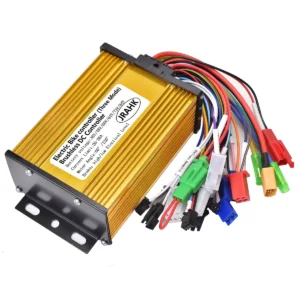
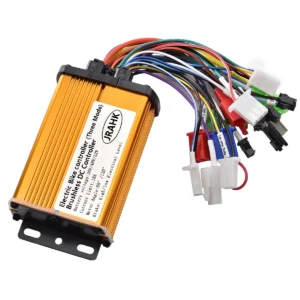
JRAHK's Three-Mode Gold Series Sine FOC Controllers (6–24 tube, 250–5000W) deliver this level of precision, balancing raw power with intelligent energy management.
5. Efficiency Gains Through Hardware Design
Efficiency isn’t only about algorithms — it’s also about hardware engineering.
JRAHK controllers use optimized electronic layouts to minimize electrical and thermal losses:
| Design Element | Efficiency Benefit |
|---|---|
| Low-Rds(on) MOSFETs | Reduce conduction losses and heat generation |
| High-frequency PWM Drivers | Improve switching precision and reduce waveform distortion |
| Thick Copper Busbars / PCB layers | Lower resistance and distribute heat evenly |
| Aluminum Alloy Housing | Acts as a natural heat sink for continuous-duty operation |
| Temperature Sensors | Enable active thermal derating for protection |
| Dual-Mode Architecture | Switches between sensored/sensorless operation for optimal control |
These choices ensure that even high-power models (up to 5000 W, 84 V) operate coolly and efficiently during sustained climbs or heavy-load usage.
6. Regenerative Braking: Turning Waste into Energy
One of the most effective ways to improve total energy efficiency is regenerative braking (regen) — converting kinetic energy back into electrical energy during deceleration.
When you brake, instead of dissipating energy as heat, the controller reverses current flow, sending power back to the battery.
FOC controllers like those from JRAHK manage this process with:
- Smooth current transitions to avoid jerks
- Adjustable braking intensity through UART or CAN interface
- Real-time voltage monitoring to prevent overcharging
This not only increases range by 5–10% but also reduces brake wear and improves overall system safety.
7. Intelligent Power Management: Adaptive Efficiency
Modern BLDC controllers employ adaptive power management, adjusting current output in response to load, terrain, and temperature.
على سبيل المثال
- During low torque demand, the controller reduces current and switches to eco mode.
- On inclines or acceleration, it delivers full current with minimal switching delay.
- When the system temperature rises, output is gradually derated to protect components.
This dynamic load balancing ensures that energy is never wasted — power is delivered only when and where it’s needed.
JRAHK controllers include such adaptive logic, ensuring optimal energy usage across riding conditions — from city commuting to hill climbing.
8. The Impact on Battery Range
A highly efficient controller has a direct effect on battery performance and lifespan.
Here’s how:
8.1 Extended Range
With a 5–10% gain in controller efficiency, a 48V 15Ah battery (720Wh) could provide an additional 3–6 km of range per charge on a typical e-bike.
8.2 Cooler Operation
Lower current losses mean less heat in both controller and motor — improving MOSFET durability and reducing thermal stress on magnets.
8.3 Longer Battery Life
By minimizing current spikes and ripple, efficient controllers reduce battery degradation over time.
FOC systems, for example, maintain smoother current draw, preventing deep-cycle stress.
For fleet operators or OEMs, this translates into tangible savings: fewer replacements, less downtime, and a more predictable total cost of ownership.
9. Efficiency Testing and Validation
At JRAHK, we measure controller efficiency through multiple test stages:
- Electrical Efficiency Bench Tests — Using precision dynamometers to record input vs. output energy under various loads.
- Thermal Imaging — Evaluating temperature rise across MOSFETs and PCB traces during continuous operation.
- Real-World Simulations — Running cycles of acceleration, braking, and hill-climbing to assess total energy usage.
- Software Optimization Loop — Refining PWM frequency, phase advance, and current limits for each model.
These validation steps ensure that every JRAHK controller performs close to its theoretical efficiency limit — consistently, in real-world conditions.
10. Case Example: FOC Controller vs Square-Wave Controller
| المعلمة | Square-Wave Controller | FOC Sine Controller (JRAHK Gold Series) |
|---|---|---|
| الكفاءة | 80–85% | 93–95% |
| Noise & Vibration | Noticeable at low speed | صامت تقريباً |
| Temperature Rise (1h @ 1000W) | +40°C | +25°C |
| Battery Range (48V 15Ah system) | ~45 km | ~50–52 km |
| تموج عزم الدوران | عالية | Negligible |
| User Comfort | معتدل | ممتاز |
This comparison highlights why FOC technology isn’t just about luxury — it’s about energy intelligence.
Every watt saved translates directly into more distance, smoother rides, and longer equipment life.
11. Future Outlook: Toward AI-Driven Efficiency
As controllers become more connected and data-driven, AI optimization will further improve energy management.
Next-generation BLDC controllers will:
- Learn driving patterns and adjust torque curves automatically
- Predictively allocate power based on terrain and load history
- Communicate with the battery and display via IoT or CAN networks to synchronize energy consumption
JRAHK’s ongoing R&D efforts in smart FOC systems و adaptive learning algorithms will bring these capabilities to our next product generation, enabling efficiency gains once thought impossible.
12. Summary: Intelligent Design for Sustainable Motion
| Efficiency Factor | How JRAHK Addresses It |
|---|---|
| Control Algorithm | Advanced FOC sine-wave architecture |
| Hardware Design | Low-loss MOSFETs + optimized PCB + thermal housing |
| Adaptive Power Management | Real-time current control + auto derating |
| الكبح المتجدد | Smooth energy recovery with protection circuits |
| System Integration | Dual-mode operation + UART/CAN connectivity |
Through continuous innovation, JRAHK BLDC controllers make every amp and volt work harder — ensuring customers achieve maximum range, stability, and lifespan in every ride.
 English
 Spanish
 Portuguese
 French
 Russian
 Korean
 Arabic
 Italian
 German